
WESTERN RAKU BURNING
A little history, the origins of raku can be traced back to the 16th century in Japan, with pieces intended for the tea ceremony. Chojir is known as the lineage of ceramists dedicated to raku, who have passed on the technique and style to their generations to this day.
It has now been modified by various Western ceramists, incorporating a chamber to generate oxygen reduction, seeking to compensate for the difference in atmospheres found in wood-fired kilns, with wood shavings or sawdust or newspaper; we use the latter two in the workshop.
Contemporary methods include bisque-firing the piece, applying low-temperature glaze, firing at 1000°C, removing it from the kiln, and placing the piece in an airtight container with some combustion element.


It is possible to perform multiple firings of the same piece, even up to 10 times. This can lead to a wonderful result or to total destruction. But the most important thing is to have fun and, above all, take care of yourself while you do it. Keep in mind that with each additional firing, the fragility of your piece increases due to accumulated thermal shocks.
The result cannot be guaranteed, as we have said before; it varies depending on the kiln, the paste and glaze recipe, the chemical composition of the ingredients in those recipes, the variation in the mixing and application of the glaze, the firing, the reduction chamber, and the combustion elements. In the workshop, we use three glazes that have a good range of performance and have been thoroughly tested in our direct-draft gas kiln, with our reduction chambers (metal jars) and the wood chips and newspaper we use.
Not all pastes are suitable for raku, only those that can withstand thermal shock. The good thing is that all of them can be adjusted to be so, for this purpose, structuring agents such as talc, fine or coarse chamotte, washed river sand, and impalpable or granular quartz are added. When adding any of these, use one or a combination of them, with a maximum total of no more than 10%. Note that the measurement is for the dry material, so you must dry your paste and then make the additions.
At La Casa del Ceramista, you'll find a ready-to-use clay labeled for raku. You can also use the national clay without adding any structural elements.


Some shapes withstand thermal shock better than others, some recommendations are: ensure that the work has homogeneous walls, of similar thickness, not too thick, try to build it in a single piece without joints (avoid squares, boxes, additions such as arms, handles, or other flat plates, those with some curve tend to be more resistant), and not too thin so that it can resist being picked up with tweezers.
In our western raku firing workshop we must adjust to the size of the kiln, you will have half a kiln, specifically the space you can use is 25 cm high and 25 cm wide. Giving you the freedom to define whether you want to fire a large piece of those maximum dimensions or several adjusting to that same space with 2 plates available.
The carbonization techniques you can choose from are:
- feathers, horsehair or sugar
- glaze for western raku.
- naked raku, for which sigilata must have been applied.
Is it necessary to apply sigilata to all pieces? No, except for Naked Raku, in which case it's necessary for the piece to have T. Sigilata and be well burnished. This is desirable for the piece to which you'll apply horsehair and feathers.
The surface treatment in the leather state allows you to obtain different results on the piece, we visualize 2 alternatives:

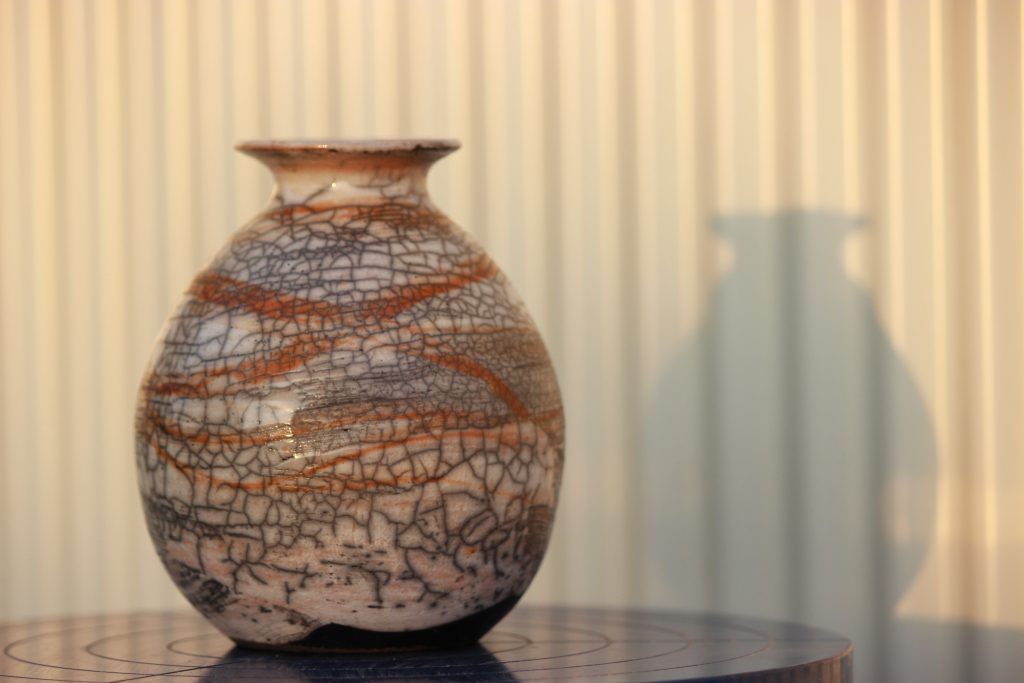
- Not performing any surface treatment will allow you to apply the enamel properly, and unenamelled surfaces will be carbonized in the reduction chamber, creating a matte, porous, black texture.
- Suavizar la superficie de la pieza mediante:
- Bruñido tradicional con piedra, ágata u otro elemento que uses habitualmente, entrega un brillo más profundo del tono de la pasta, en ocasiones metalizado por la carbonización, además aporta un tipo diferente de craquelado en la superficie esmaltada.
- Aplicar Tierra Sigilata ofrece un paño del color de la T. Sigilata (la puedes pigmentar, resultados interesantes con O. cobre, fierro o cobalto). Recomendamos bruñir la pieza de forma tradicional en estado de cuero, aplicar sigilata con pincel (3 a 4 capas), bruñir con bolsa plástica y finalmente volver a bruñir la pieza. Entrega un brillo más profundo metalizado por la carbonización, además aporta un tipo diferente de craquelado en la superficie esmaltada y al usar el esmalte transparente se visualizan los tonos de la sigilata utilizada.
Enameling alternatives:
- Use of exclusive enamel: white, transparent or turquoise, by dipping, dripping or brushing.
- Apply coloring oxides with a brush over the enamel.
- Make enamel reserves with floor wax, to highlight the carbonization of the paste.
- Combination of the above.
American raku firing is built on unpredictability and change, so take advantage of this. Glazing by dipping, dripping, brushing, or spraying can all deliver different colors and effects; the thickness of the glaze is also a factor that can vary the color.
IMPORTANT TOPICS:
- Bring pieces built with the recommendations in this text, especially respecting the maximum measurements, in a combination of measurements (not all with the maximum measurements).
- Bring clothing that protects you from the heat. Shoes should be closed with non-slip soles, ideally leather, long pants (avoid polyester or those with metal fasteners), and a long-sleeved T-shirt or sweatshirt to cover your arms. Additionally, if the smoke bothers you, a mask is recommended.
- Bring individual or shared snacks if the group is interested; food is not included in the workshop. We have a grill, brazier, or oven to heat whatever you like.
- Arrive on time so as not to delay the first burning.


